LLC vs Sole Proprietorship: What Actually Changes

Small Business Specialist
Kimberly Burton
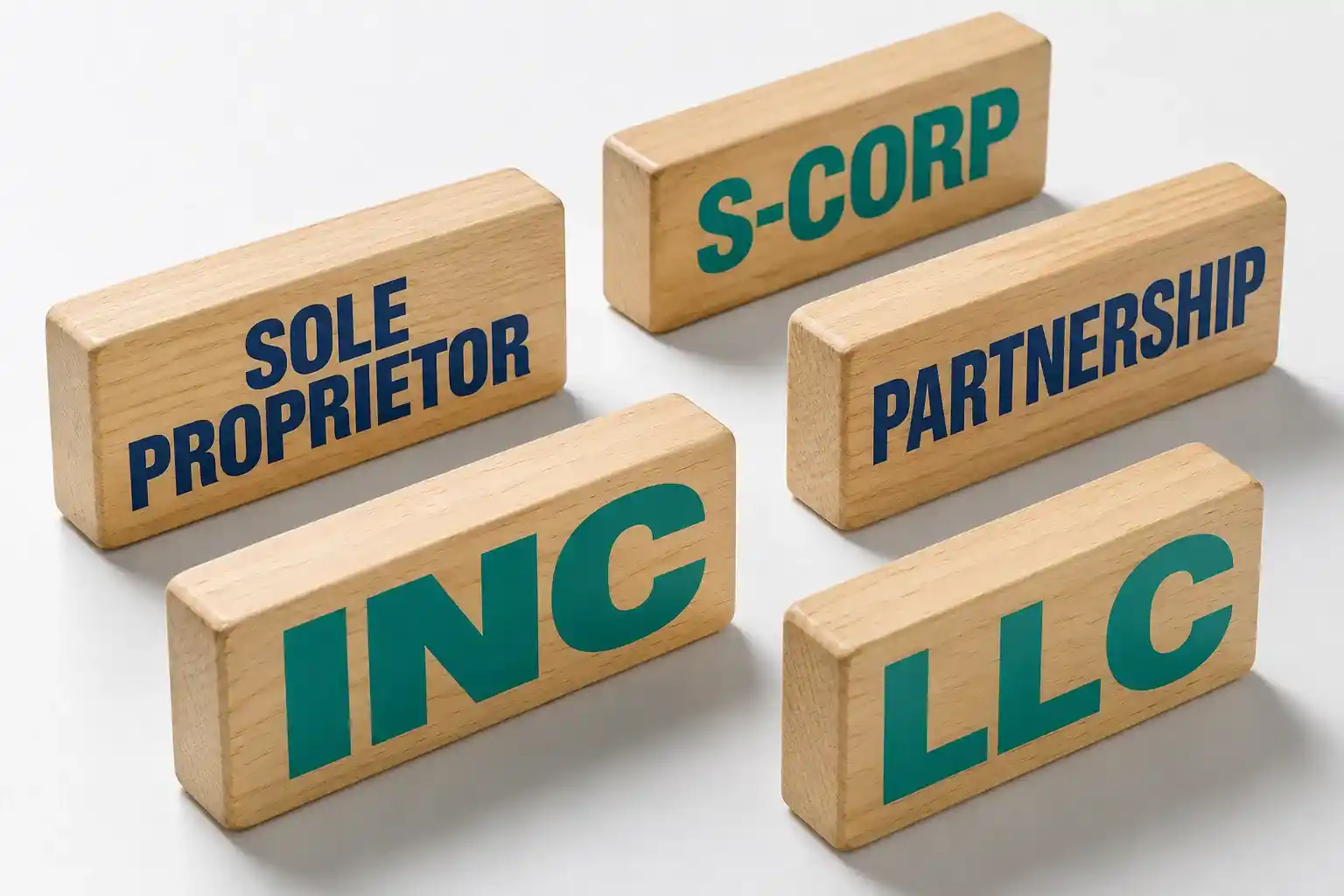
An LLC changes one thing that matters and one thing that does not.
It changes who is on the hook when something goes wrong. It does not change your federal tax return, at least not by default. Most articles on this comparison get the second half wrong, so start there.
Key takeaways
- A single-member LLC and a sole proprietorship file the same federal return: Schedule C, with the same 15.3% self-employment tax.
- The real difference is liability. As a sole proprietor, you and the business are the same legal person, so creditors can reach your personal assets.
- Forming costs $35 to $500 in state fees. Keeping it running costs $289 to $1,788 over three years depending on your registered agent.
- Protection is not absolute. Personal guarantees, your own negligence and mixed bank accounts all cut straight through it.
- The IRS counted 31.0 million returns with sole proprietorship activity for tax year 2022, and single-member LLCs are inside that number.
The tax myth worth clearing up first
An LLC does not lower your tax bill. Not by itself.
The IRS treats a single-member LLC as a disregarded entity, which means it is ignored for federal income tax and the owner reports business profit on Schedule C. A sole proprietor files the same Schedule C. Same form, same deductions, same 20% pass-through deduction.
Self-employment tax is identical too: 15.3%, made up of 12.4% for Social Security on earnings up to $184,500 in 2026 and 2.9% for Medicare with no ceiling (IRS). Forming an LLC does not reduce it by a dollar.
Here is the proof hiding in the federal data. The IRS Statistics of Income programme counted 31.0 million individual returns reporting nonfarm sole proprietorship activity for tax year 2022, carrying $410.7 billion in profits (IRS SOI).
That 31 million includes every single-member LLC in the country. A disregarded entity files the same schedule as a bare sole proprietor, so the IRS data cannot tell them apart. If forming an LLC changed the tax treatment, they would be counted separately. They are not, because it does not.
Two real tax differences do exist, and both come later:
- An S corp election. Once profit comfortably exceeds a reasonable salary, electing S status can reduce the self-employment portion. That election is available to an LLC and not to a sole proprietorship. See LLC vs S corp.
- Multi-member LLCs. Two or more members means partnership treatment and Form 1065, which is genuinely different paperwork.
So the honest framing: form an LLC for the liability shield, and treat any tax benefit as a door it opens later rather than a saving it delivers today.
What a sole proprietorship actually is
It is the default. Start selling products, offering services or freelancing without forming anything, and you are a sole proprietor automatically. There is no filing and no fee.
What that gets you:
- Instant start, no state paperwork
- Complete control over every decision
- One tax return, with business income on Schedule C
What it does not get you: any separation between you and the business.
What unlimited liability means in practice
In the eyes of the law, you and your sole proprietorship are one person. There is no company to sue, so a claimant sues you.
That means a business debt is your debt. A judgment against the business is a judgment against you. Creditors can pursue your bank account, your car, and in many states your home, subject to state homestead protections.
The exposure is not evenly distributed. Ask three questions:
- Do you have customers on your premises or your product in their hands? Physical risk raises the odds of a claim sharply.
- Do you sign contracts with meaningful obligations? A missed deliverable becomes a personal liability.
- Do you have assets worth reaching? A claimant chasing somebody with nothing recovers nothing. Equity in a home changes that calculation.
If all three answers are no, the risk is genuinely low. If any is yes, the annual cost of an LLC buys a lot of protection.
What an LLC changes, and where it stops
An LLC is a separate legal person. It signs the contracts, owes the debts and gets sued. Your personal assets sit outside that boundary.
What you gain beyond the shield:
- Credibility. Banks, larger clients and some marketplaces treat a registered entity differently. Opening a business account is simpler.
- Continuity. The company can survive a change of owner. A sole proprietorship ends with the proprietor.
- A path to grow. Adding members, taking investment or selling the business all work more cleanly with an entity.
- A name on the public record. Your entity name is registered with the state, which is not the same as a trademark but does stop another LLC registering it in your state.
Now the part that gets skipped. The shield has four standard holes:
- Anything you personally guarantee. Banks and landlords routinely require one from a new LLC. Signing puts your personal assets back behind that specific debt.
- Your own negligence. An LLC does not stop somebody suing you personally for what you did. This is what professional liability insurance is for.
- Unpaid payroll taxes. The IRS can pursue responsible individuals for trust fund taxes withheld and not remitted.
- A company you have not kept separate. Paying personal bills from the business account is the most common way a court is handed a reason to disregard the entity.
Three of those four are within your control. Separate bank account, separate records, contracts signed in the company name, and insurance where the work carries real risk. That routine is what makes the legal wall hold.
What it costs
Two bills, only one optional.
The state filing fee is set by your state and runs from $35 in Montana to $500 in Massachusetts. Most states then charge an annual or biennial report fee. A sole proprietorship pays neither, which is its genuine cost advantage.
The service fee is optional. You can file the articles of organization yourself; formation services sell convenience and a registered agent.
The recurring cost is the registered agent, not the filing:
| Provider | Year 1 | Year 2 | Year 3 | 3-year total |
|---|---|---|---|---|
| Northwest | $39, agent free | $125 | $125 | $289 |
| ZenBusiness | $0 + $99 agent | $199 | $199 | $497 |
| Tailor Brands | $0 + $199 agent | $199 | $199 | $597 |
| LegalZoom | $0 + $249 agent | $249 | $249 | $747 |
| Swyft Filings | $0 + $596 agent | $596 | $596 | $1,788 |
Our calculation from each provider's published rates on 18 August 2026, cheapest formation plan plus registered agent, excluding state fees. At the low end that is under $100 a year for the protection described above.
Side by side
| Sole proprietorship | LLC | |
|---|---|---|
| Setup | Automatic, no filing | Articles of organization plus state fee |
| Cost to start | $0 | $35 to $500 state fee |
| Cost to keep | $0 | Annual report plus registered agent |
| Personal liability | Unlimited | Limited, with the four exceptions above |
| Federal tax form | Schedule C | Schedule C if single-member |
| Self-employment tax | 15.3% | 15.3% |
| 20% pass-through deduction | Eligible | Eligible |
| S corp election available | No | Yes |
| Registered agent required | No | Yes, in most states |
| Survives the owner | No | Yes |
| Name protected in state | No | Yes |
When a sole proprietorship still makes sense
Three situations where staying unregistered is a reasonable call:
You are testing. The idea might not work. Prove somebody will pay before adding a state fee and an annual filing.
Your risk is genuinely low. Freelance writing for a handful of clients, with no premises, no employees and no physical product, carries little of the exposure described above.
You have no assets to protect. If there is nothing to reach, the shield protects less than it costs. That changes the moment you buy a home.
Note what is not on that list: revenue. People often wait for a revenue milestone. Liability does not track revenue, it tracks what you do and who you do it with. A single $500 job installing something in a customer's house carries more exposure than $50,000 of remote consulting.
Converting later
Converting works and is common. You form the LLC, get a new EIN, move contracts and accounts across, and start filing under the new entity.
Two practical notes. Protection is not retrospective, so a claim arising from work done before the LLC existed stays with you personally. And the admin is real: bank accounts, client contracts, payment processors and licences all need updating.
Forming from the start is simpler than converting mid-stream. Our step-by-step guide is in how to register a business, and the wider decision is covered in starting a business.
Choosing a formation service
Four of the five providers we track file an LLC for $0 plus your state fee. What separates them is the recurring cost and what they bundle.
- Northwest charges $39 to file and includes the first year of registered agent service. At $125 a year afterwards it is the cheapest to keep running, and its Privacy by Default practice keeps your home address off public filings.
- ZenBusiness files for $0, includes a free first year of Worry-Free Compliance, and has the strongest dashboard and support of the group. It does not form nonprofits.
- Tailor Brands bundles branding, a domain and a website with the filing. Its free Lite plan takes up to 14 business days; one-day filing sits on the paid plans. It forms LLCs only.
- LegalZoom is the only one with an attorney network, which matters if your questions go past the paperwork. Its registered agent is the most expensive here at $249 a year.
Full scoring is on our best LLC services chart, and the method is in how we rank.
Common questions
Does an LLC save me money on taxes? Not by default. A single-member LLC files the same Schedule C as a sole proprietor and pays the same self-employment tax. Savings can come later from an S corp election.
Do I need an EIN as a sole proprietor? Only if you hire employees or meet certain other conditions. Many sole proprietors use their Social Security number. An EIN is free from the IRS and worth getting anyway to keep your SSN off client paperwork.
Can I use a business name as a sole proprietor? Yes, by registering a DBA, or "doing business as", with your state or county. A DBA is a name registration and gives you no liability protection at all. See how to form a DBA.
Will an LLC protect me if I am sued personally? No. It protects your personal assets from claims against the business. A claim about your own conduct reaches you either way, which is what professional liability insurance covers.
What is the single biggest mistake after forming? Mixing personal and business money. It undermines the exact protection you paid for, and it is the first thing an opposing lawyer looks for.
This article is for educational purposes only and is not legal or tax advice. Federal tax figures reflect 2026 rules and provider prices were read on 18 August 2026. Consult a qualified professional for guidance specific to your situation.
Liked this article?

Kimberly Burton
 Related Articles



Recommended LLC Services