LLC vs S Corp: When the Election Starts Paying

Small Business Specialist
Kimberly Burton
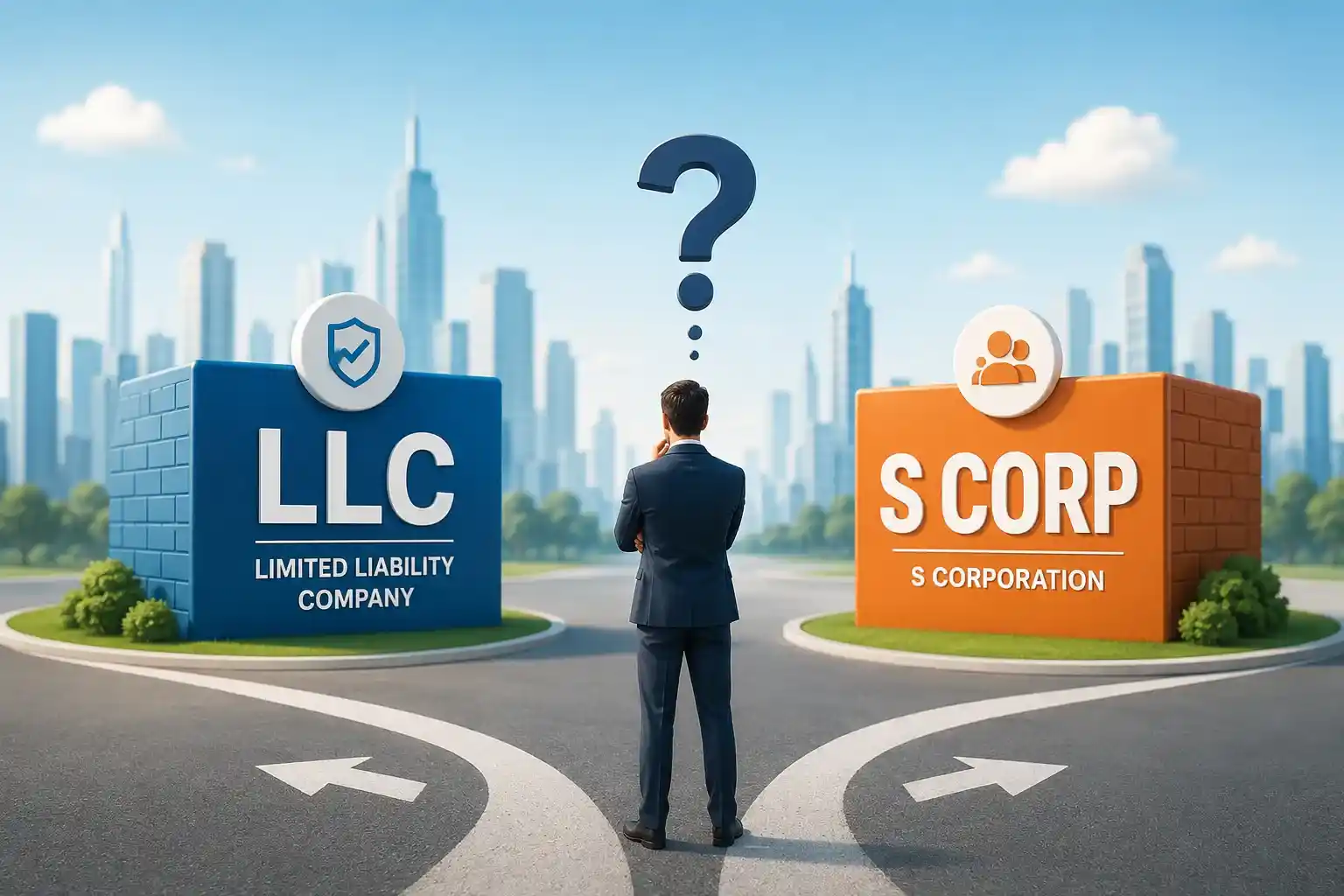
These are not two options you pick between. An LLC is a legal structure. An S corp is a tax election that an LLC can make.
You can have both at once, and most people who "switch to an S corp" never change their company at all. They file one IRS form and keep the same LLC.
Key takeaways
- Electing S status does not change your entity. Your LLC stays an LLC under state law.
- The saving comes from one place: splitting profit into salary (payroll tax applies) and distributions (it does not).
- At $100,000 of profit with a $60,000 salary, the split saves roughly $4,950 in self-employment tax before costs.
- Payroll, a second tax return and an accountant cost $1,500 to $2,500 a year, which is why the election rarely pays below about $60,000 of profit.
- Some states tax S corps anyway. California adds 1.5% of net income and New York City ignores the election entirely.
Why the comparison is usually framed wrong
An LLC is created by filing articles of organization with a state. An S corporation is created by filing Form 2553 with the IRS. Different governments, different documents, different purposes.
By default the IRS treats a single-member LLC as a disregarded entity and a multi-member LLC as a partnership. Elect S status and the same LLC is taxed under subchapter S instead. Nothing about the company changes: same name, same registered agent, same operating agreement, same liability protection.
This matters because of a widespread and expensive misunderstanding. To have your LLC taxed as an S corp you do not file articles of conversion with your state. You do not convert to a corporation. You do not issue stock or appoint a board of directors. Those are corporate law requirements for actual corporations. An LLC electing S treatment keeps membership interests and its existing management structure, and the only filing is the federal one.
What the election actually changes
One thing: how your profit is split for payroll tax.
As a default LLC owner, you are self-employed. Self-employment tax applies to essentially all your net profit at 15.3%, made up of 12.4% for Social Security up to $184,500 in 2026 and 2.9% for Medicare with no ceiling (IRS).
Elect S status and you become an employee of your own company. You pay yourself a salary, which carries payroll tax. Profit above that salary comes out as a distribution, which does not.
Income tax does not change. The profit still lands on your personal return either way. Only the payroll portion moves.
What it actually saves
Here is the same business at three profit levels, comparing default LLC treatment against an S election with a reasonable salary.
| Annual profit | Salary set at | SE tax as default LLC | Payroll tax as S corp | Saving before costs |
|---|---|---|---|---|
| $60,000 | $45,000 | $8,478 | $6,885 | $1,593 |
| $100,000 | $60,000 | $14,130 | $9,180 | $4,950 |
| $200,000 | $100,000 | $28,234 | $15,300 | $12,934 |
Assumptions: self-employment tax applies to 92.35% of net profit, the 2026 Social Security wage base of $184,500 applies, and both employer and employee payroll halves are counted because the owner pays both. Income tax, state tax and the pass-through deduction are excluded. Your figures will differ.
Read the first row carefully. A $1,593 saving sounds fine until you subtract what the election costs to run, which is the next section. That is where the break-even sits.
Reasonable compensation: the rule that caps it
The obvious move is to set the salary near zero and take everything as a distribution. The IRS closed that door.
An owner-employee must receive reasonable compensation for the work actually performed before distributions are taken. There is no fixed formula. The tests look at duties, hours, experience, what comparable roles pay in your market, and what the business could pay somebody else to do the job.
Paying yourself $10,000 on $200,000 of profit is one of the more reliable ways to attract examination. If the IRS reclassifies distributions as wages, you owe the payroll tax anyway, plus interest and penalties.
The practical read: the saving is real but bounded. It applies to the slice of profit above a defensible salary, not to the whole thing.
What the election costs to run
This is the half most comparisons skip, and it decides whether the election is worth making.
- Payroll. You now run real payroll with withholding, quarterly Form 941 filings and annual Form 940, plus a W-2 for yourself. A payroll service runs roughly $500 to $1,000 a year.
- A second tax return. An S corp files Form 1120-S with a Schedule K-1 for each shareholder. That is a separate return on top of your personal one, and it usually means paying a preparer.
- Accounting. Most owners who elect S status stop doing their own taxes. Budget $500 to $1,500.
- State filings. Some states add their own S corp registration or annual requirements.
Call it $1,500 to $2,500 a year all in. Set that against the table above and the shape becomes clear:
| Profit | Saving before costs | Roughly break-even? |
|---|---|---|
| $60,000 | $1,593 | No. Costs eat it |
| $100,000 | $4,950 | Yes, net saving around $2,500 to $3,500 |
| $200,000 | $12,934 | Comfortably |
That is why the common advice to elect S status "once you are profitable" is too vague. The threshold is not profitability, it is profit above a reasonable salary large enough to clear a fixed annual overhead.
The state trap
Federal savings can be reduced or wiped out by state treatment, and this is the part almost no comparison mentions.
Most states follow the federal election. Several do not, or tax S corps at the entity level anyway:
- New York City does not recognise the S election. S corps operating there pay the General Corporation Tax, the same as C corps.
- California imposes a franchise tax on S corps of 1.5% of net income, with an $800 minimum.
- Others to check include the District of Columbia, Louisiana, New Hampshire and Tennessee, which either do not fully recognise the election or impose entity-level taxes.
Run the California case against the table above. On $100,000 of profit the federal saving is roughly $4,950, but 1.5% of net income is another $1,500 in state franchise tax, and the annual overhead still applies. The election can still make sense there, but the margin is much thinner than a federal-only calculation suggests.
Check your own state before electing, not after.
Who is allowed to elect
The eligibility rules are hard limits. Per the IRS, an S corporation must:
- Be a domestic entity
- Have no more than 100 shareholders
- Have only one class of stock, or one class of membership interest for an LLC
- Have owners who are individuals, certain trusts or estates
- Not have partnerships, corporations or non-resident alien owners
- Not be an ineligible corporation, such as certain financial institutions and insurance companies
Two of those quietly rule out common plans. A co-founder living abroad without US residency blocks the election. And venture funds, being partnerships or corporations, cannot hold an interest in an S corp, which is why funded startups use C corporations instead. That comparison is in S corp vs C corp.
How to actually make the election
One form, filed with the IRS.
File Form 2553 within two months and 15 days of the start of the tax year you want it to apply to. For calendar-year 2026 that is March 16, 2026, because March 15 falls on a Sunday. Every owner has to sign.
Miss the date and the election generally takes effect the following year. There is a relief route if you have reasonable cause: write "FILED PURSUANT TO REV. PROC. 2013-30" at the top of the form.
Once elected, you file Form 1120-S annually with a K-1 for each owner, plus the employment tax returns that come with payroll.
One thing worth knowing before you commit: revoking an S election generally means waiting five years before you can elect again without IRS consent. The election is easy to make and slow to unwind.
Side by side
| LLC, default treatment | LLC with S election | |
|---|---|---|
| Legal entity | LLC | LLC, unchanged |
| Federal return | Schedule C or Form 1065 | Form 1120-S |
| Owner is | Self-employed | Employee plus owner |
| Payroll tax applies to | All net profit | Salary only |
| Payroll required | No | Yes |
| Ownership limits | None | 100 owners, US persons, one class |
| Foreign owners | Allowed | Not allowed |
| Annual admin cost | Low | $1,500 to $2,500 higher |
| 20% pass-through deduction | Eligible | Eligible |
| Liability protection | Same | Same |
Liability protection is identical, which is worth stating plainly. The S election is a tax decision and changes nothing about what creditors can reach.
Common questions
Do I need to form a corporation to be an S corp? No. An LLC can elect S treatment by filing Form 2553. No state conversion, no stock, no board of directors.
Does the election change my liability protection? No. Protection comes from the LLC itself and is unaffected by how the IRS taxes it.
What salary should I pay myself? Whatever is reasonable for the work you do, judged against comparable market pay. There is no safe-harbour percentage, despite the rules of thumb you will read. This is the question worth paying an accountant for.
Can a single-member LLC elect S status? Yes, if it meets the eligibility rules. You become the sole shareholder and an employee of your own company.
When should I elect? When profit sits comfortably above a reasonable salary by enough to clear roughly $2,000 a year of extra overhead, and after checking how your state treats S corps.
Where to form the LLC first
The election is federal, but you need the LLC first. All five providers we track file one for $0 to $39 plus your state fee.
ZenBusiness files for $0 plus state fees, includes a free first year of Worry-Free Compliance, and rates 4.8 on Trustpilot across 32,128 reviews on its own reviews page. It forms LLCs, S corps and C corps, though not nonprofits.
Northwest charges $39 and includes the first year of registered agent service, then $125 a year. It is the cheapest to keep running, which matters more than the filing fee.
Swyft Filings files the widest range of entity types, including nonprofits and DBAs, if you expect to need more than one.
Full comparison on our best LLC services chart, with the method in how we rank. If you are still choosing a structure rather than a tax treatment, start with what is an LLC, LLC vs sole proprietorship or LLC vs corporation.
Federal tax figures reflect 2026 rules. Calculations are our own from published rates and exclude income tax, state tax and the pass-through deduction. This content is not legal, financial or accounting advice; the reasonable compensation question in particular is worth professional input.
Liked this article?

Kimberly Burton
 Related Articles



Recommended LLC Services