LLC vs Corporation: How to Pick the Right Structure

Small Business Specialist
Kimberly Burton
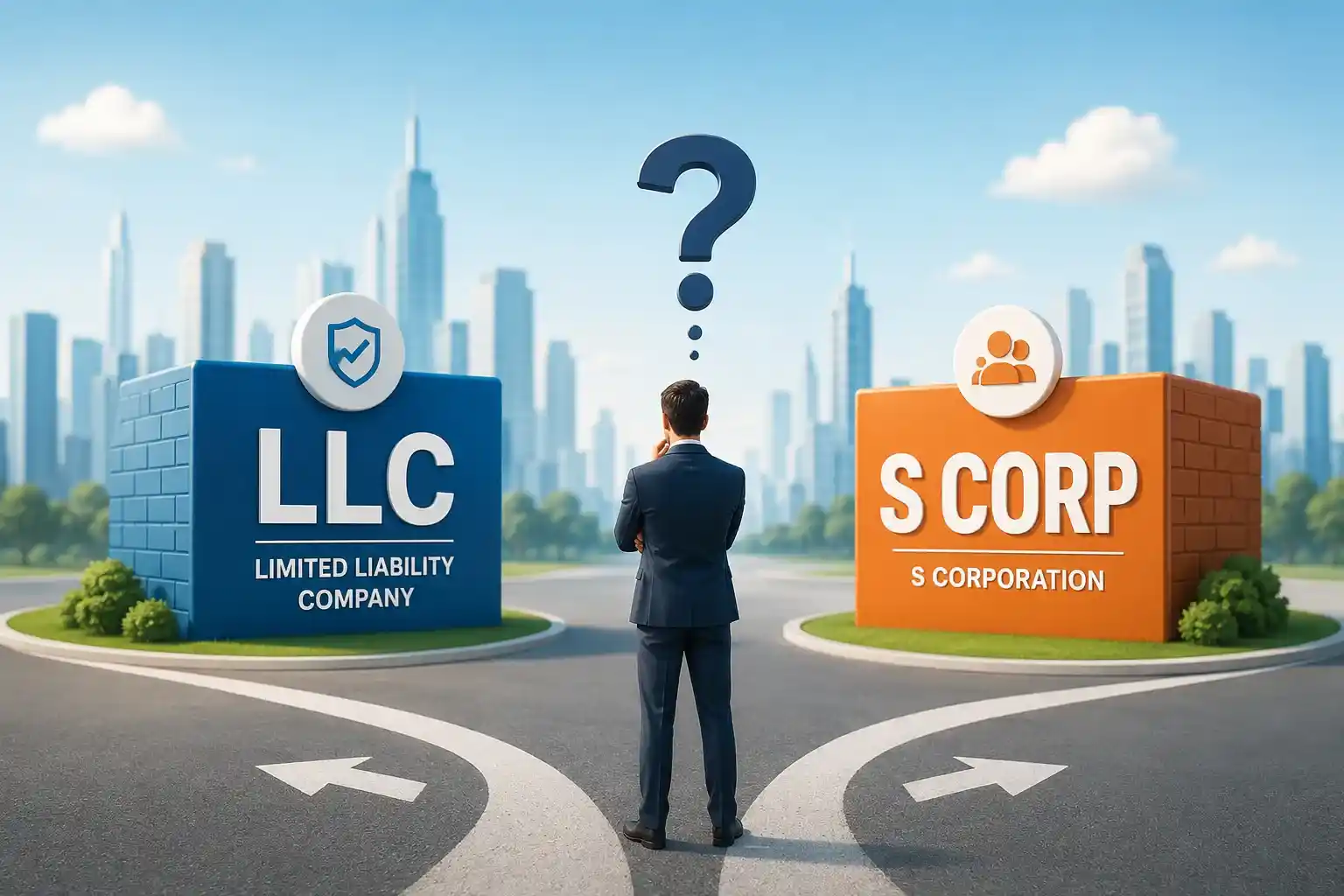
Most comparisons present three options in a row: LLC, C corp, S corp. Pick one.
That list is wrong, and the error costs people money. Two of those are legal structures you form with a state. The third is a tax election you file with the IRS. They sit on different axes, and you choose on both.
Key takeaways
- LLC and corporation are legal structures. S corp is a tax election either one can make.
- An LLC can be taxed four different ways. A corporation can be taxed two. The structure does not fix the tax treatment.
- Corporations carry formalities an LLC does not: bylaws, a board, annual meetings, minutes and a stock ledger.
- Delaware costs real money to keep. $300 a year for an LLC, from $225 for a corporation, on top of your home state.
- Choose a corporation for outside investors or QSBS. Choose an LLC for almost everything else.
The two axes, drawn out
Here is the structure the usual three-item list hides.
| Formed with | Default federal tax | Can elect | |
|---|---|---|---|
| LLC, one member | State | Disregarded, Schedule C | S corp or C corp |
| LLC, two or more members | State | Partnership, Form 1065 | S corp or C corp |
| Corporation | State | C corp, Form 1120 | S corp |
So an LLC has four possible tax treatments and a corporation has two (IRS). "LLC or S corp" is not a choice between two things. It is a structure plus an election, and the same LLC can be both.
The clearest proof of the two-axis point sits in the IRS's own statistics, which cannot count LLCs at all. A single-member LLC appears among the 31.0 million returns reporting sole proprietorship activity. A multi-member LLC sits inside the 4.5 million partnership returns, where LLCs make up 72.7% of the total. An LLC that elected S status is filed on Form 1120-S alongside actual corporations, in a category totalling roughly 5.3 million returns with Form 1120.
Three different piles, one legal structure, no marker distinguishing it. If structure and tax treatment were the same axis, the IRS would only need one pile.
What each costs to run
Formation cost is nearly identical. Ongoing cost is not.
Both pay the same state filing fee, from $35 in Montana to $500 in Massachusetts, and most states charge an annual or biennial report fee afterwards. Both need a registered agent, which is the real recurring line at $125 to $596 a year depending on the provider. Our best LLC services chart has the full comparison.
A corporation adds an annual tax return the LLC may not need. An LLC taxed as a disregarded entity files no separate return at all; the profit goes on Schedule C. A corporation always files, either Form 1120 or Form 1120-S, which usually means paying a preparer.
A corporation also adds formalities, and this is the part people underestimate.
Corporate formalities: what you are signing up for
An LLC is governed by an operating agreement you can write in a page. A corporation is governed by statute, and the statute has requirements.
What a corporation must maintain:
- Bylaws setting out how the company is governed
- A board of directors, elected by shareholders
- Annual shareholder meetings and usually annual board meetings
- Minutes of those meetings, kept as a permanent record
- A stock ledger recording who owns what and when it changed
- Board resolutions for major decisions, such as opening a bank account or issuing shares
None of that is optional just because you are the only shareholder. These formalities are part of what keeps the liability shield intact. Skip them all and you hand an opposing lawyer an easy argument: no meetings, no minutes, no stock issued, so treat the company as if it were never there.
An LLC has none of these requirements in most states. That gap is the single biggest practical reason small businesses pick the LLC, and it is worth more than any tax argument for an owner who will not maintain a minute book.
The Delaware question
The advice to incorporate in Delaware is repeated constantly and applies to almost nobody reading this.
Delaware is the right answer for one group: companies raising money from venture funds. Investors expect it. Its Court of Chancery is a specialist business court with decades of case law, and every startup lawyer knows the paperwork.
For everyone else it means paying twice. Form in Delaware but trade from Ohio, and you must register in Ohio as well. Two filings, two registered agents, two sets of fees, one company.
And Delaware itself is not free:
| Delaware annual cost | |
|---|---|
| LLC | $300 flat franchise tax, due June 1, no annual report |
| Corporation, authorized shares method | From $175 franchise tax plus $50 annual report, due March 1 |
| Corporation, assumed par value method | From $400, plus the $50 report |
| Either method, maximum | $200,000 |
Figures from the Delaware Division of Corporations. Corporations may calculate both ways and pay the lower amount, which is why startups with millions of authorized shares should check the second method before paying the first.
Add your home state on top of those numbers and the "Delaware is cheaper" claim collapses for a normal small business.
When a corporation genuinely wins
Three situations, and only three, where the extra formality earns its place.
You are raising venture capital. Funds are partnerships or corporations, which cannot hold S corp stock, and they expect preferred shares, which an S corp cannot issue because of the one-class-of-stock rule. A C corporation is the only structure that fits a priced round.
You will keep profit in the business rather than take it out. A C corp pays 21% and stops there until money comes out. An LLC owner is taxed on their share of profit whether or not the cash ever leaves. Reinvest everything and the second tax layer never arrives.
You might qualify for QSBS. Qualified Small Business Stock under Section 1202 lets shareholders exclude capital gain on the sale of qualifying C corporation stock. Only C corps qualify. Legislation signed on July 4, 2025 raised the exclusion cap to $15 million, lifted the company gross asset limit to $75 million, and replaced the flat five-year holding period with a tiered schedule starting at 50% after three years (Holland & Knight). For a founder who might exit early, that change matters.
Outside those three, the corporation is usually paying formality costs for benefits it will never use.
Side by side
| LLC | Corporation | |
|---|---|---|
| Formed with | State | State |
| Default federal tax | Pass-through | C corp, 21% flat |
| Tax elections available | S corp or C corp | S corp |
| Owners | Unlimited members, any type | Unlimited shareholders, any type |
| Bylaws and board required | No | Yes |
| Annual meetings and minutes | No | Yes |
| Stock ledger | No | Yes |
| Can issue preferred shares | Not applicable | Yes |
| Suits venture funding | No | Yes |
| QSBS eligible | No | Yes, if a C corp |
| Owner salary | Only with an S or C election | Yes |
Which to pick
Pick an LLC if you are a small operating business, the ownership stays with a handful of people, and you would rather not run a minute book. That covers most readers of this page. You can add an S election later when profit supports payroll, which is set out in LLC vs S corp.
Pick a corporation if you are raising outside investment, retaining profit for growth, or building toward an exit where QSBS could apply. The tax comparison between the two corporate flavours is in S corp vs C corp.
Pick neither yet if you are still testing whether the idea works. Operating as a sole proprietor is legal, free and reversible, though it leaves your personal assets exposed. The trade is set out in LLC vs sole proprietorship, and the wider decision in starting a business.
Common questions
Is a corporation more protective than an LLC? No. Both create a separate legal person, and both protections fail in the same places: personal guarantees, your own negligence, unpaid payroll taxes and mixing personal with business money.
Can I convert an LLC to a corporation later? Yes. Most states allow statutory conversion, and it is a common step before a funding round. Converting is more work than starting as a corporation, but far less work than maintaining corporate formalities for years you did not need them.
Do I need a lawyer to incorporate? Not for a straightforward single-state entity. Formation services handle it for $0 to $39 plus the state fee. A lawyer earns their fee once you have co-founders, outside money or a share structure more complex than one class.
Does an LLC pay corporate tax? Not by default. It is pass-through unless you elect corporate treatment on Form 8832.
Which structure lets me pay myself a salary? A corporation does. An LLC does once it elects S or C corp treatment. A default LLC owner takes draws rather than wages, and pays self-employment tax on the profit.
Which filing service to use
All five services we rank file LLCs in all 50 states. What separates them is entity coverage and what happens after the filing.
- ZenBusiness files LLCs, S corps and C corps for $0 plus state fees, with a free first year of Worry-Free Compliance and 1-day processing on the $199 Pro plan. It does not form nonprofits.
- Swyft Filings files the widest range: LLCs, S corps, C corps, nonprofits and DBAs, from $0 plus state fees. Its registered agent is billed quarterly and works out near $596 a year.
- LegalZoom files corporations and nonprofits and is the only one with an attorney network, which is worth having when a share structure gets complicated. Registered agent runs $249 a year.
- Northwest charges $39 and includes the first year of registered agent service, then $125 a year. Cheapest to keep running.
- Tailor Brands files LLCs only, with no corporation, nonprofit or DBA product. Its free Lite plan takes up to 14 business days; one-day filing sits on the paid plans.
If you know you need a corporation or a nonprofit, that list narrows to three: Swyft Filings, LegalZoom and ZenBusiness for corporations, and Swyft Filings or LegalZoom for nonprofits. Scoring method is in how we rank.
Two corporation variants sit outside this comparison and carry their own rules. Licensed trades usually file a professional corporation, which shields you from a partner's malpractice but never your own. A mission-led company can file a benefit corporation, which widens what directors must weigh without changing the tax bill at all.
This article is for educational purposes only and is not legal or tax advice. Tax figures reflect 2026 federal rules and provider prices were read on 18 August 2026. Consult a qualified professional for guidance specific to your situation.
Liked this article?

Kimberly Burton
 Related Articles



Recommended LLC Services