S Corp vs C Corp 2026: Tax Rules and Which to Pick

Small Business Specialist
Kimberly Burton
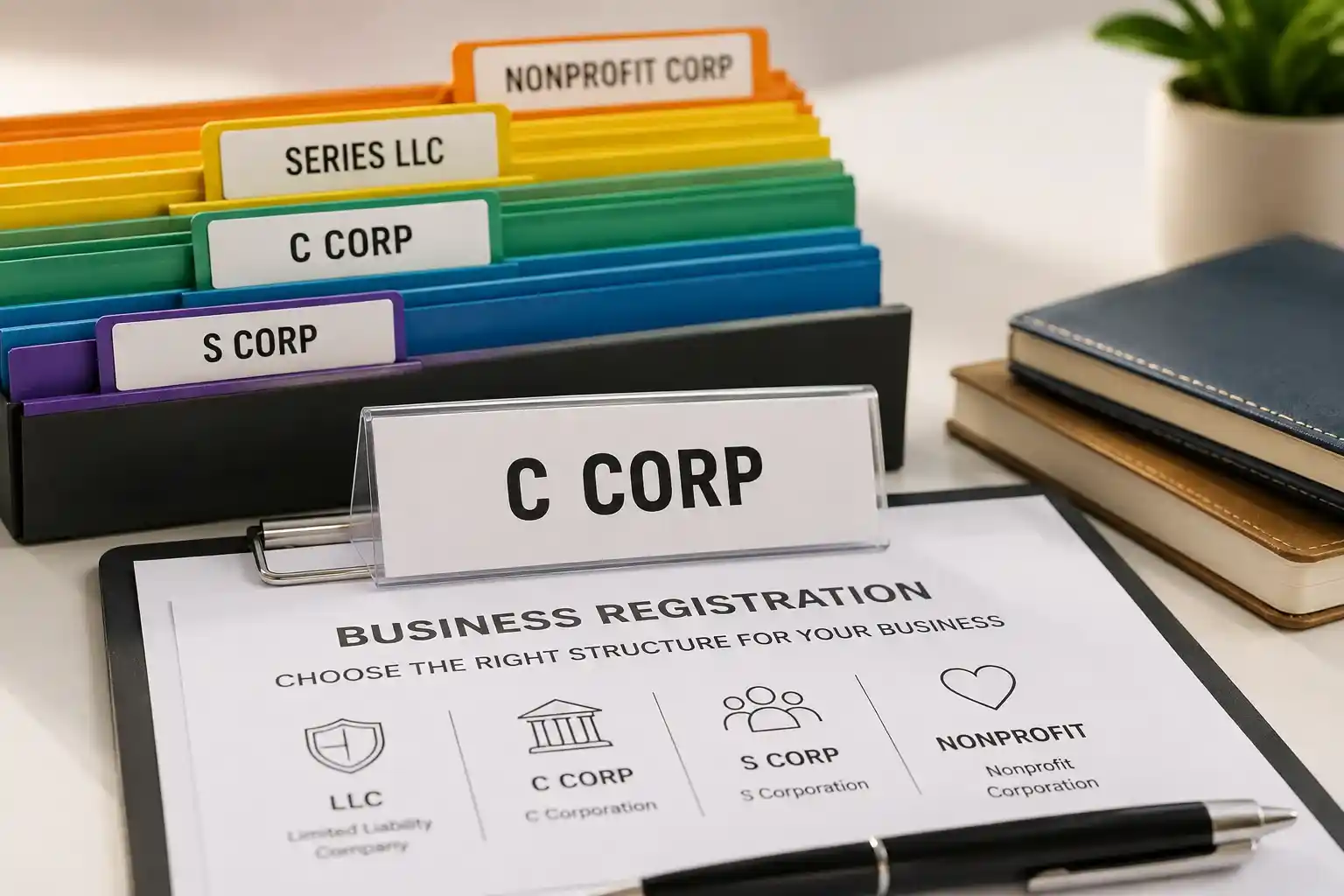
Both are corporations. Only one of them is a separate taxpayer.
That single sentence resolves most of the confusion. A C corporation pays its own federal income tax at 21%, then shareholders pay again on dividends. An S corporation pays no federal income tax of its own. Profit passes to the owners and lands on their personal returns.
Key takeaways
- C corp: taxed at a flat 21% federal rate, then dividends are taxed again at the shareholder level, up to 23.8% including the net investment income tax.
- S corp: no entity-level federal tax, but the IRS caps it at 100 shareholders, one class of stock, and no non-resident alien, partnership or corporate owners.
- To elect S status for calendar-year 2026 you file Form 2553 by March 16, 2026. Miss it and there is a late-relief route.
- S corp owners can qualify for the 20% pass-through deduction, made permanent in July 2025. C corp shareholders cannot.
- The best argument for a C corp got stronger in 2025. QSBS now excludes up to $15 million of gain, with partial exclusions from year three.
The distinction that causes all the confusion
An S corporation is not a type of company. It is a tax election.
You form a corporation under state law, or an LLC, and then you choose how the IRS should tax it. Elect nothing and a corporation is taxed under subchapter C. File Form 2553 and it is taxed under subchapter S instead.
The company itself does not change. Same articles of incorporation, same registered agent, same state filings, same liability protection. What changes is which chapter of the tax code applies to the profit.
This is why "should I be an LLC or an S corp" is a malformed question. An LLC is a legal structure. An S corp is a tax treatment an LLC or a corporation can adopt. Both can be true at once, which is covered in LLC vs S corp.
How each one is actually taxed
Start with the mechanics, then look at what they cost.
C corporation. The company pays federal income tax at a flat 21% on its profit. When it distributes what is left as dividends, shareholders pay again. Qualified dividends are taxed at 0%, 15% or 20%, depending on income. A further 3.8% net investment income tax applies once modified adjusted gross income passes $200,000 single or $250,000 married filing jointly. The top combined rate on a dividend reaches 23.8%.
S corporation. No federal tax at the company level. Profit is allocated to shareholders on Schedule K-1 and taxed on their personal returns at their own rates, whether or not the cash is actually distributed.
Here is the same $100,000 of profit run through both, assuming everything is distributed.
| Path | Entity tax | Shareholder tax | Owner keeps |
|---|---|---|---|
| C corp, dividend taxed at 15% | $21,000 | $11,850 | $67,150 |
| C corp, top rate plus NIIT (23.8%) | $21,000 | $18,802 | $60,198 |
| S corp, owner in the 24% bracket | $0 | $24,000 | $76,000 |
| S corp, 24% bracket with the 20% QBI deduction | $0 | $19,200 | $80,800 |
Assumptions: $100,000 of profit, fully distributed, federal only. State tax, payroll tax and the reasonable-compensation split are excluded. Your own numbers will differ; this shows the shape of the gap, not your bill.
The pattern holds across most small-business income levels. When profit is paid out, the S corp usually wins, and the pass-through deduction widens the gap. That deduction was set to expire at the end of 2025. Legislation signed on July 4, 2025 made it permanent at 20% (Tax Foundation). So any advice written before mid-2025 understates the S corp side.
The C corp case is not about paying out. That is the point of the next two sections.
Who is allowed to own an S corp
The eligibility rules are hard limits, not guidelines, and breaking one can terminate the election. Straight from the IRS, an S corporation must:
- Be a domestic corporation
- Have no more than 100 shareholders
- Have only one class of stock
- Have shareholders who are individuals, certain trusts or estates
- Not have partnerships, corporations or non-resident alien shareholders
- Not be an ineligible corporation, such as certain financial institutions, insurance companies and domestic international sales corporations
Two of those quietly rule out common plans. Venture funds are usually partnerships or corporations, so they cannot hold S corp stock. A co-founder living abroad without US residency counts as a non-resident alien. That blocks the election outright.
The one-class-of-stock rule is the third trap. Preferred shares with a liquidation preference, the standard instrument in a priced funding round, are a second class. Issue them and the S election ends.
The deadline that catches people out
To have S status apply for a calendar tax year, Form 2553 must be filed within two months and 15 days of the start of that year. For 2026 that means March 16, 2026, because March 15 falls on a Sunday.
File late and the election generally takes effect the following year instead. There is a relief route: if you have reasonable cause, you can request late-election relief under Revenue Procedure 2013-30 by writing "FILED PURSUANT TO REV. PROC. 2013-30" at the top of the form.
Every shareholder has to sign. On the ongoing side, an S corp files Form 1120-S with a Schedule K-1 for each shareholder, plus the usual employment tax returns once it runs payroll.
Where a C corp actually wins, and it got stronger in 2025
The honest case for a C corp has almost nothing to do with the 21% rate. It is about who can invest, what happens to retained profit, and one rule most small-business articles never mention.
Qualified Small Business Stock, under Section 1202, lets shareholders exclude capital gain on the sale of qualifying C corporation stock. Only C corps qualify. S corps and LLCs do not.
Legislation signed on July 4, 2025 made it considerably more valuable (Holland & Knight):
| Before | For stock issued after July 4, 2025 | |
|---|---|---|
| Company gross asset cap | $50 million | $75 million, indexed for inflation after 2026 |
| Exclusion cap | $10 million or 10x basis | $15 million or 10x basis |
| Holding period | 5 years for 100% | 3 years: 50%. 4 years: 75%. 5 years: 100% |
The tiered schedule is the part worth pausing on. QSBS used to be all or nothing at five years, so an exit at year four returned no exclusion at all. Now year three carries a 50% exclusion and year four 75%. For a founder who might sell early, that turns a binary bet into a sliding scale.
Note the cut-off. These terms apply only to stock issued after July 4, 2025. Shares issued before that date keep the old rules.
Three other C corp advantages are worth listing plainly:
- Unlimited shareholders, any type. Venture funds, foreign investors and corporate investors can all hold stock.
- Retained earnings taxed once. Profit left in the business is taxed at 21% and stops there. There is no second layer until it is distributed. An S corp owner is taxed on allocated profit whether or not the cash ever leaves the company.
- Fringe benefits. Health premiums and certain benefits for owner-employees get better treatment than in an S corp, where owners holding more than 2% are treated differently.
Reasonable compensation: the S corp catch
The classic S corp saving comes from splitting income into salary and distributions. Salary carries payroll tax. Distributions do not.
The limit is that the IRS requires reasonable compensation for the work an owner-employee actually does. Pay yourself a token $10,000 salary on $200,000 of profit and you invite an audit. If the IRS reclassifies it, you owe back taxes, interest and penalties.
Running payroll costs money too: filings, a payroll provider, and usually an accountant. If a fair salary eats most of the profit, little is left to take as distributions. At that point the savings do not cover the overhead. Where the line falls depends on your own numbers, so price it with an accountant rather than a blog.
Side by side
| S corporation | C corporation | |
|---|---|---|
| Federal entity tax | None | 21% flat |
| Second layer on distributions | No | Yes, up to 23.8% |
| Shareholder limit | 100 | Unlimited |
| Foreign shareholders | Not allowed | Allowed |
| Corporate or fund shareholders | Not allowed | Allowed |
| Classes of stock | One | Multiple |
| 20% pass-through deduction | Eligible | Not eligible |
| QSBS exclusion | No | Yes |
| Profit taxed if not distributed | Yes | No |
| Main annual return | Form 1120-S | Form 1120 |
Which one to pick
Pick an S corp if you are running a profitable owner-operated business, taking money out, and the ownership stays with a small group of US individuals. The absence of a second tax layer and access to the pass-through deduction is hard to beat at that scale.
Pick a C corp to raise venture capital, take foreign or institutional investors, hold profit inside the business, or aim at an exit where QSBS could apply. The double layer only bites on distributions. A company that reinvests everything may never trigger it.
Pick neither yet if you are still finding out whether the business works. Form an LLC, keep the default pass-through treatment, and add an S election later when profit justifies payroll. You can convert. Undoing an S election, by contrast, carries a five-year wait before re-electing. Compare the structures in LLC vs corporation.
Corporation filing services
Not every formation service files corporations. Of the five we track, these handle the full range.
Swyft Filings
The widest entity coverage on our chart: LLCs, S corps, C corps, nonprofits and DBAs, in all 50 states and Washington, D.C.
Pros
- Corporation filing from $0 + state fees
- Files five entity types, including nonprofits
- Standard package adds an operating agreement, organizational minutes and banking essentials for $169
- Free business tax consultation and lifetime support
Cons
- Registered agent is billed at $149 a quarter, roughly $596 a year
- Several documents are priced a la carte
Read our full Swyft Filings review for the pricing detail.
LegalZoom
Corporations, nonprofits and estate planning, plus the only attorney network among the services we track. Pro and Premium include a 30-day attorney subscription that renews at $49 a month, which is worth knowing before you rely on it for entity questions. Registered agent runs $249 a year, the highest on our chart. See the LegalZoom review.
Two providers on our chart do not form corporations at all: Tailor Brands files LLCs only, and ZenBusiness does not support nonprofit formation. Check entity coverage before you pay, because a service that cannot file your entity type is not cheaper, it is unusable.
Common questions
Is an S corp a type of company? No. It is a federal tax election. The underlying company is a corporation or an LLC formed under state law.
Can my LLC be an S corp? Yes, if it meets the eligibility rules. You file Form 2553 and the LLC keeps its legal form while being taxed under subchapter S.
What happens if I break an eligibility rule? The election can terminate, and the company reverts to C corporation treatment. Common triggers are admitting an ineligible shareholder or creating a second class of stock.
Can I switch from S corp back to C corp? Yes, by revoking the election. Note that after terminating an S election you generally have to wait five years before electing S status again without IRS consent.
Does the 21% rate mean a C corp is cheaper? Only until you take money out. On distributed profit the combined federal cost typically lands near 40% at the top, against a single layer for an S corp. Retain the profit and the picture reverses.
Tax figures reflect federal rules for the 2026 tax year and the changes enacted on July 4, 2025. Rates, thresholds and eligibility rules change. This content is not legal, financial or accounting advice; check your own position with a qualified professional before electing.
Liked this article?

Kimberly Burton
 Related Articles



Recommended LLC Services